Is Gianni Infantino’s Grip on FIFA Slipping? Inside the Crisis and Who Could Replace Him
For nearly a decade, Gianni Infantino has been one of the most powerful men in world sport.
But in the weeks since the 2026 World Cup final, his position at the top of FIFA has come under pressure unlike anything he’s faced since replacing the disgraced Sepp Blatter in 2016.
Here’s the full story of how it unravelled — and who might be waiting in the wings.
How It Started: The FFE Plan
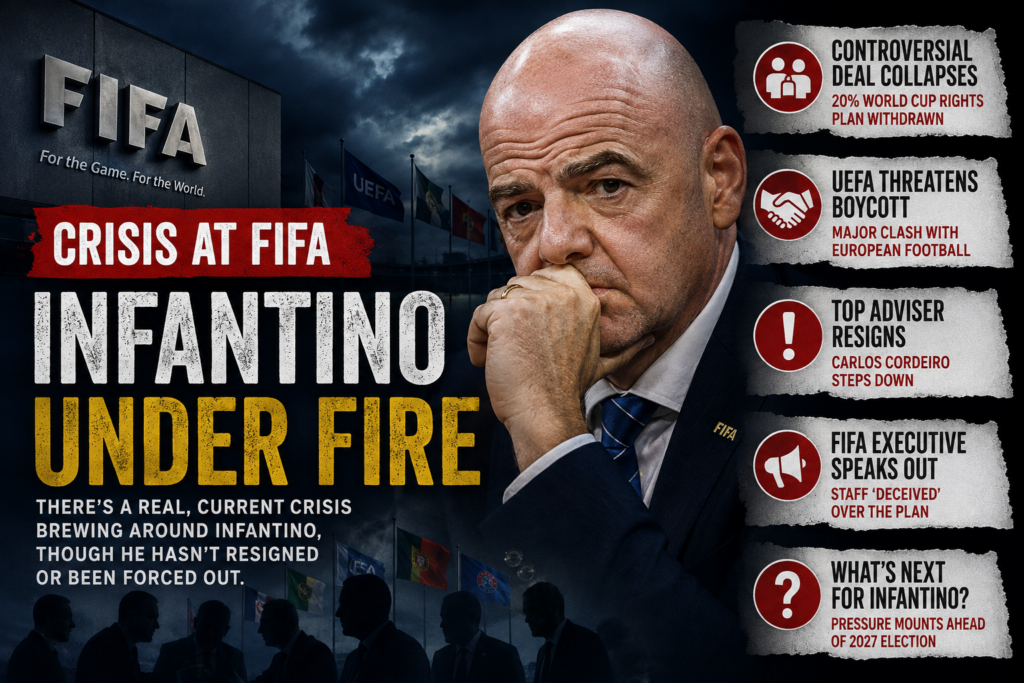
Just days after the final whistle blew on a hugely profitable 2026 World Cup, Infantino announced FIFA’s “Forward Enterprise” (FFE) plan — a proposal to bring in private investors as peripheral owners of World Cup assets.
The idea, in simple terms, was to sell a stake in football’s biggest tournament to raise fresh capital.
It backfired almost immediately.
Critics were quick to point out that FIFA hardly needs the money. The organisation is reportedly sitting on billions of dollars in reserves with no debt, and generated an estimated $15 billion in revenue between 2022 and 2026 alone.
Against that backdrop, opponents argued that selling a permanent stake in the World Cup to raise roughly $4.2 billion made little financial sense — critics called it mortgaging football’s future without a compelling reason to do so.
The Backlash Builds
The reaction from football’s power centres was swift and severe:
- UEFA was first out of the gate, rejecting the plan outright and threatening to boycott every future FIFA competition — both the men’s and women’s World Cups included — unless the proposal was abandoned entirely, with binding guarantees it would never resurface.
- CONCACAF and the Asian Football Confederation followed with their own rejections, though neither threatened a boycott of the scale UEFA did.
- Infantino’s own senior advisor, Carlos Cordeiro, resigned from his position in protest, saying plainly that he couldn’t stand by while FIFA considered selling a stake in the World Cup.
The pressure compounded further when at least one UEFA member federation reportedly withdrew its letter of support for Infantino’s anticipated re-election — a genuinely rare crack in what has historically been an uncontested path for him at FIFA Congress.
It Wasn’t Just About Money
The financial controversy landed on top of an already tense World Cup for Infantino personally.
He’d faced criticism throughout the tournament for what many described as an atmosphere of aggressive commercialism around the event. Adding fuel to the fire:
- A controversial decision to suspend a red card shown to USMNT striker Folarin Balogun ahead of the last-16 match against Belgium — a reversal that reportedly followed a direct phone call from US President Donald Trump to Infantino personally, drawing criticism from human rights and governance groups.
- The introduction of a “FIFA Peace Prize,” with Trump as its first recipient, which raised eyebrows given the closeness of the Infantino-Trump relationship throughout the tournament.
- A pointed letter to the Argentine Football Association praising the team’s “professionalism” after their final defeat to Spain — criticised by some as tone-deaf given prior friction involving Argentine players during the tournament.
- Public criticism from figures inside the game itself, including former FIFA referee and ex-PGMOL chief Keith Hackett, who argued Infantino should be voted out, saying the extra revenue he’s generated doesn’t outweigh how he’s allowed politics to dominate the organisation.
Infantino responded to mounting criticism with a pointed Instagram post aimed at his critics, and separately defended FIFA’s independence over the Balogun decision, pointing to the disciplinary committee’s formal authority over the ruling.
So — Is He Actually On His Way Out?
Not imminently, based on current reporting. There appears to be little real appetite within FIFA for a formal vote of no confidence, despite the idea reportedly being floated at the last Congress. Infantino has not indicated that he intends to step down.
The more realistic scenario being discussed is different: rather than removing him mid-term, opponents are increasingly expected to treat the next FIFA presidential election — expected at the FIFA Congress in Morocco in March 2027 — as their opportunity to mount a genuine challenge. Infantino has been re-elected unopposed twice already; this would be the first time in years he potentially faces a real contest.
Who Could Replace Him?
Speculation has already turned to potential successors, with several names circulating:
Victor Montagliani (CONCACAF President, Canadian) Perhaps the most talked-about name. Montagliani was a constant, familiar presence throughout the 2026 World Cup as CONCACAF co-hosted the tournament, and has led the confederation for a decade.
He’s seen as someone who could appeal to federations outside football’s traditional elite. That said, people close to him say his immediate priority is securing his own re-election as CONCACAF president first.
Nasser Al-Khelaifi (Paris Saint-Germain President) As chairman of the European Football Clubs association (formerly the European Clubs’ Association), Al-Khelaifi has more than a decade of experience at the top of one of Europe’s biggest clubs, and oversaw the organisation’s expansion to over 800 member clubs following the collapse of the European Super League.
However, sources suggest he currently has little real interest in the FIFA presidency and would need serious persuading to run.
Patrice Motsepe (CAF President, Mamelodi Sundowns Owner) The South African has led the Confederation of African Football since 2021 and is believed to harbour long-term ambitions of the top job. But as a close Infantino ally, he’s considered more likely to wait for the 2031 election — when Infantino will be term-limited out entirely — rather than challenge him directly now.
Dariusz Mioduski (Legia Warsaw Owner, Polish lawyer) Discussed as a potential backup European candidate, particularly if Al-Khelaifi declines to run. Reportedly the preferred option for Poland’s federation specifically.
Sheikh Salman bin Ebrahim Al Khalifa (AFC President) No stranger to FIFA elections — he finished as Infantino’s closest rival in the 2016 vote that first brought Infantino to power. He’s led the Asian Football Confederation since 2013 and was just re-elected unopposed for a fourth term running through 2027.
Beyond these named candidates, football federations from Bosnia, Norway, Sweden, Germany and Spain have also reportedly discussed backing an alternative candidate, suggesting the appetite for a genuine contest extends well beyond a single challenger.
The Bottom Line
Infantino isn’t gone, and there’s no clear sign he’s preparing to step aside. But the FFE controversy has done real damage — costing him a senior advisor, a chunk of institutional goodwill, and quite possibly his long-standing status as FIFA’s unchallenged, unopposed leader. Whether this becomes a genuine turning point or blows over before March 2027 is still very much an open question. Worth watching closely as it develops.
This story is developing. Details reflect the most recent reporting available at time of writing and may change as the situation unfolds.